How Able Marga works —
and why it works
Everything here is written in plain language — no jargon, just what it means for your child.
Nurture-led pacing
Every child moves at their own rhythm. We celebrate small wins & build momentum.
Real neuroscience
Methods rooted in how children truly learn — accessible, kind & effective.
Plain language support
No confusing educational jargon — just clear roadmaps for families.
Why functional academics
Why functional academics is the right choice for children with autism and special needs
Traditional Academics
Reading, writing, arithmetic, science, history. These prepare most children for higher education. For children whose cognitive profile makes that pathway unlikely, traditional academics can become a source of daily failure — content they cannot access, assessed in ways that cannot show what they actually know.
Functional Academics
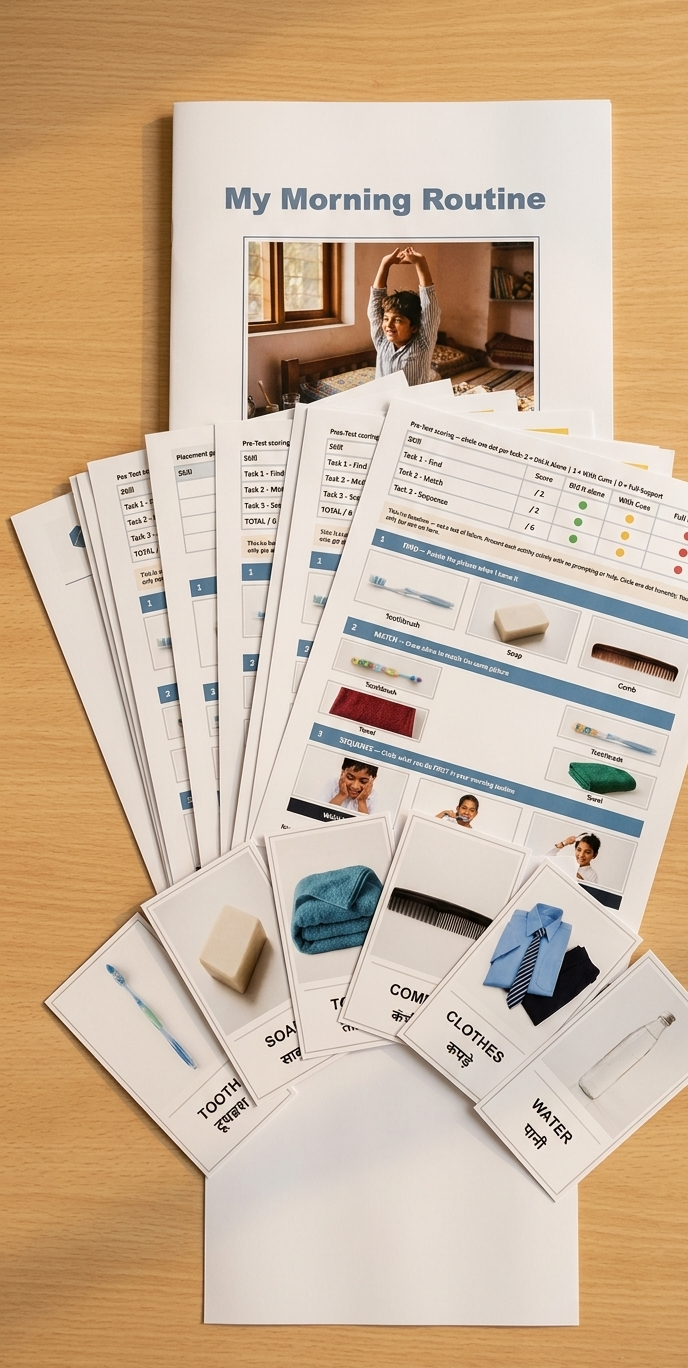
Reading food labels, counting money, following a morning routine, staying safe in the community. These are the skills that determine the quality of a person's daily life — regardless of their cognitive profile. They build independence and reduce caregiver burden.
"For children with autism, Down syndrome and intellectual disability, functional academics is not a lesser option. It is the right option. Every skill your child learns has immediate, visible, daily application."
See the Curriculum → Browse All 11 Units
Why structured curriculum beats ad-hoc worksheets
Every parent, therapist or special educator of a child with autism or special needs has done the worksheet search. You spend hours on a Sunday planning — and then your child doesn't respond the way you hoped. So you search again.
The problem is not the individual worksheets. The problem is the absence of structure around them.
A deliberate sequence
Each unit builds on the one before it, ensuring skills are introduced logically.
A baseline
The pre-test tells you exactly where your child is starting, removing guesswork.
Progression
Each worksheet in a unit is slightly more demanding than the last to ensure steady growth.
Measurement
The post-test tells you exactly what your child has learned, providing data for reports.
Generalisation
Every unit ends with real-life practice activities so skills transfer beyond the paper.
Clear guidance
You know what you are doing, why you are doing it, and whether it is working.
How Able Marga fits alongside
therapy and special education
For families working with a therapist
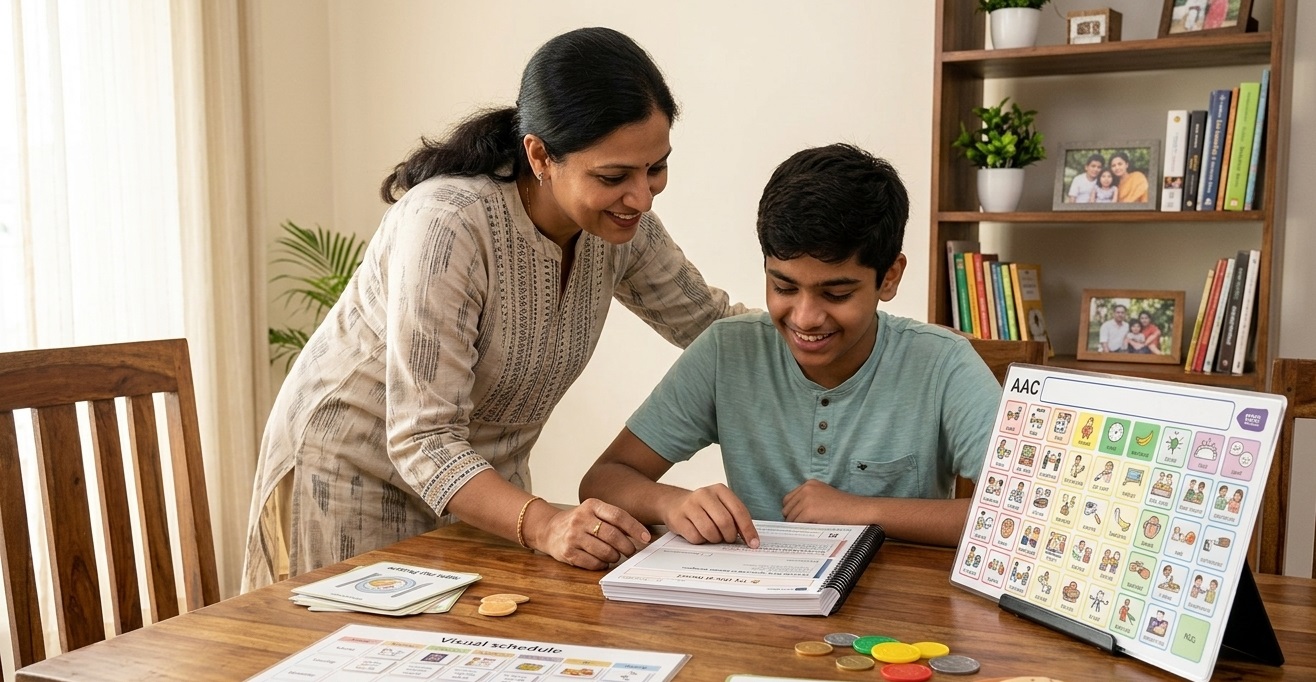
Share the unit at the start of each month. Your therapist uses the same worksheets in sessions — so your child practises the same skills in therapy and at home. Skills practised daily generalise faster. Progress compounds.
For families connected to a school
Able Marga complements what your child learns at school. Pre and post-test data can feed into school reviews, parent meetings, and annual assessments. Special educators can use the same materials in resource rooms.
For families working without support
The guidance notes everywhere give you the professional knowledge you need, in the moment you need it. You are not expected to know applied behaviour analysis. You follow the guidance on the page.
How to use at home
Any parent, family member, therapist, or special educator can use Able Marga. You do not need a special education qualification. You need a printer, 15–20 minutes a day, and the willingness to sit with your child.
Guidance notes include:
Step 1 — Download the free placement guide
Read a few simple observations about your child's current skills. Tick what applies. The guide tells you which level to start at. Takes five minutes.
Step 2 — Purchase or get Unit 1
Download the PDF. Print the pre-test pages first. Each unit is 23 pages — a full year of curriculum is approximately 260 pages.
Step 3 — Administer the pre-test
10–15 minutes. You present each item and note your child's response. Instructions on the page — no training needed.
Step 4 — Daily worksheets
One per day, Monday to Friday. Use the guidance notes on every page for support.
Step 5 — Use the word cards
Cut out and place on the bathroom mirror, breakfast table, in your bag. Consistent exposure across the day accelerates learning.
Step 6 — Administer the post-test
Repeats the items. Compare the two score sheets. See exactly what your child has learned over the past month.
Step 7 — Share & Earn
Share our QR code with another parent and get the first unit of your next level absolutely free.
The whole process from placement to first worksheet takes less than one morning. Most families are ready to start on Day 1.
Download the Placement Guide + Free Unit 1 Today →
"More and more Indian families are choosing to homeschool children with special needs — because mainstream schools cannot meet their child's needs."
For homeschooling families
More and more Indian families are choosing to homeschool children with special needs — because mainstream schools cannot meet their child's needs, or because their child thrives at home with the right structure. Parents, therapists and special educators are partnering in new ways to support each child.
- A complete daily structure — open the next worksheet. No planning required.
- A full year of content — 11 units that build systematically across the year.
- Six levels — so as your child grows, the curriculum grows with them.
- Four subjects — Life Skills, Functional English, Functional Maths, and Social & Communication Skills.
- Measurable progress — pre and post-tests every month give you documentation of growth.
- Guidance notes everywhere — how to run, sensory tips, interoception tips, safety notes.