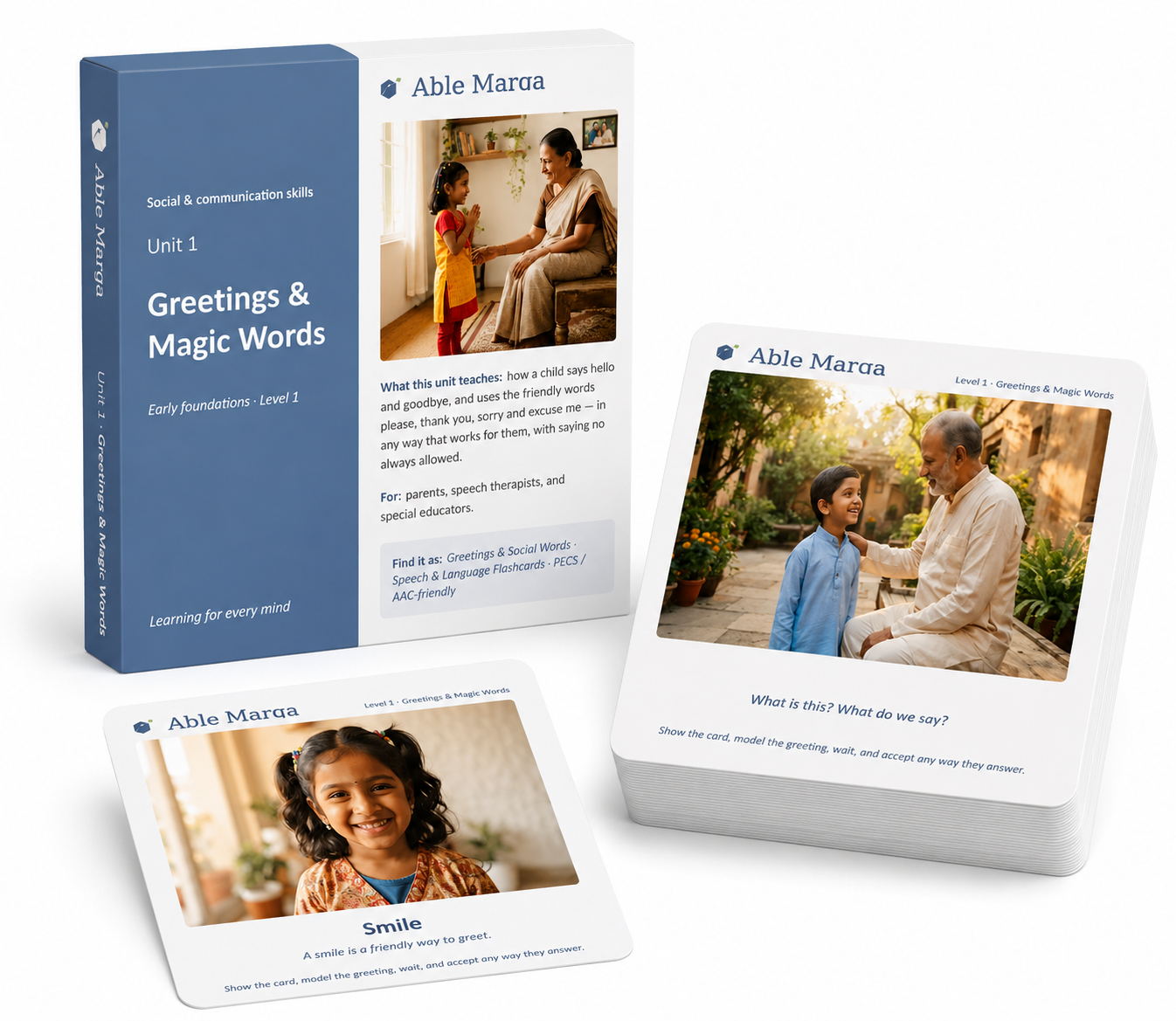
Greet
Say hello, goodbye, namaste and friendly words in the learner's own way.
All four Level 1 subjects are live — structured printable PDFs for functional learning. Explore Level 1 →
Social & Communication Skills · Level 1 available
Designed around the learner
The cards are built for learners who benefit from clear pictures, practical language and more than one way to respond. Adults can use the same material while adapting prompts, pace and communication mode.
Pointing, signing, exchanging a picture or tapping a device all count. Speech is never the entry requirement.
Start with one motivating request, one greeting or one clear choice and expand only when it becomes useful.
Parents, speech and language therapists, special educators and support teams can use the same visual language across settings.
Simple enough for everyday use
Use the cards inside a real moment rather than as a long quiz. Start with a word the learner needs or an item they genuinely want, model the communication, wait and respond.
Begin with a favourite request, a greeting used every day or a clear yes-and-no choice.
Show the card or response in the real situation. Avoid repeatedly asking the learner to perform.
Give genuine processing time. Do not interrupt a developing response with another instruction.
A look, point, reach, card exchange, sign, sound, word or device tap can communicate the message.
Honour the message quickly, then practise with another person or in another place when the learner is ready.
Level 1 is available now
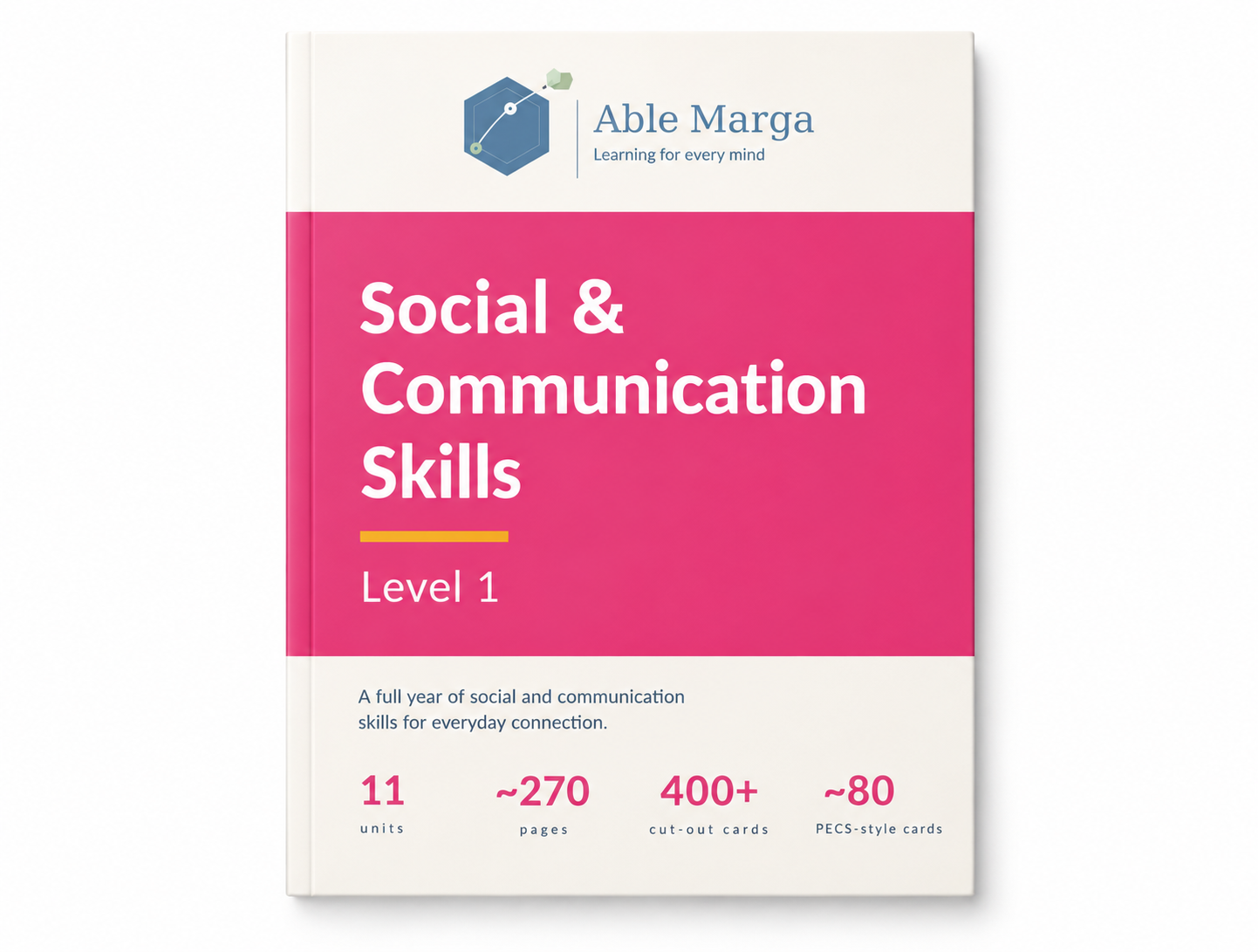
A full year of picture-based communication practice for home, school or therapy—ready to print, prepare and use.
Available nowEleven sequenced units covering greetings, requests, choices, body needs, emotions, actions, WH questions, sequencing, turn-taking and helpers.
Digital printable product. Access is provided after successful purchase; no physical item is shipped.
Frequently asked questions
These picture-based social skills and communication activities are designed for flexible use by parents, educators and therapists.
They are the everyday abilities to connect with others—greeting, requesting, choosing, showing feelings, taking turns and answering simple questions. Able Marga teaches each through picture-based cards that accept a look, gesture, sign, picture, sound, word or AAC button.
Yes. Every activity allows a non-speaking learner to respond by looking, pointing, signing, exchanging a picture or using a communication device. Speech and eye contact are never required.
AAC is the broad category of non-speech communication, including signs, picture boards and devices. PECS is one specific picture-exchange protocol within AAC. Able Marga includes picture-exchange-style requesting activities and other AAC-friendly visual tools; it does not claim to replace formal PECS training.
Yes. Each card includes a straightforward prompt a parent can follow. Begin with one motivating message, model it, wait five seconds, accept any response and reduce help gradually. A therapist can still help tailor communication goals when needed.
No. Communication can happen without eye contact. Looking towards the card, reaching, moving closer, handing over a picture, signing, vocalising or tapping a device can all carry a clear message.
A learner who can refuse a hug, greeting or optional choice has a clearer route to self-advocacy. Adults should honour that message. For essential safety or health routines, offer choices and use “first, then” rather than asking a false yes-or-no question.
Treat the behaviour as information. Identify the likely need, model the simplest card, sign or device response that expresses it, and respond quickly when the learner uses that calmer communication. Reduce the task if distress is rising.
A large community study across five Indian regions reported that roughly one in eight children aged 2–9 had at least one neurodevelopmental condition, while autism affected about one in 100 children in the younger age group. Estimates vary by study and method; these figures describe populations, not any individual child. Read the PLOS Medicine study.
Yes. Open the free Social & Communication sample to review the picture style, prompts and response options before choosing the complete Level 1 curriculum.
Choose the complete Level 1 curriculum or try a real sample first. Start with what motivates the learner, accept their communication mode and build one successful exchange at a time.