
My Name
Recognise the learner's own name in print.
All four Level 1 subjects are live, plus skill packs and speech therapy resources. Printable PDFs for functional learning. Shop now →
Functional English curriculum · Level 1 available
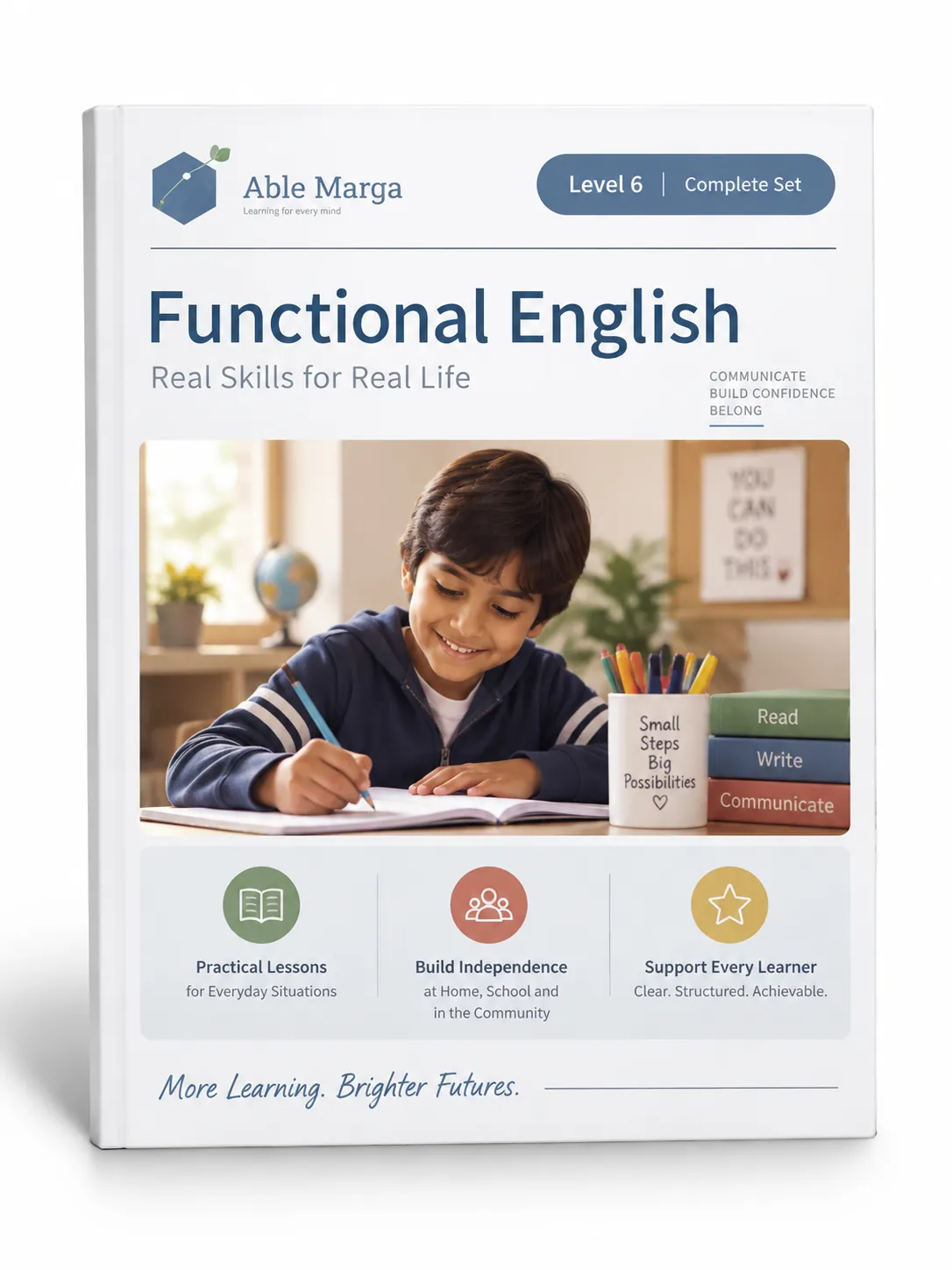
Able Marga's Functional English curriculum is a print-ready, picture-supported reading programme for children with special needs. It builds meaning-first reading through familiar words, pictures and real-life print, for parents, therapists and special educators. Level 1 begins with the learner's own name, then introduces everyday objects, action words, safety signs, symbols, family names, colours and food.
Not sure where to begin? Use the free Placement Guide →
Meaning-first reading
Level 1 treats each useful word as a meaningful visual form. A picture or real object supports understanding first; repeated practice then helps the learner recognise the printed word at home and in the community.
Connect the word to a familiar person, object, action, sign or symbol.
Point to, touch or place the correct word card beside its picture.
Reduce visual support gradually as the printed word becomes familiar.
Spot the same word on a door, device, packet, book or family label.
A consistent four-week rhythm
The page style remains predictable while the vocabulary changes. Learners meet the words gently, practise with support, find them in daily life and then show what they recognise.
Introduce a small set of useful words with full picture support and no pressure.
Repeat the same words through clear choices while prompts gradually reduce.
Spot the words at home, on signs, on food packets, on devices and during outings.
Mix the words, try them with less support and complete the mastery check.
Independent speech, reading or writing is not required to begin Level 1.
Preview a free sample →Functional English FAQ
Level 1 is designed for guided, meaning-first reading. The learner can begin by recognising and responding to useful words without being expected to speak or write.
Begin with a meaningful word and a clear visual connection, such as the learner's own name or the word CUP beside a cup. Ask them to look, point, touch or place a word card. Speech is not required to demonstrate recognition.
No. Level 1 focuses on meaning-first whole-word recognition. Learners meet useful printed words as visual forms supported by pictures and real-life context. Letters and phonics are introduced in later learning, after a practical word foundation has developed.
Receptive language is the ability to understand words, signs and instructions. A learner may understand and select the word TOILET, for example, even if they do not say it aloud. Level 1 strengthens this understanding through recognition and choice.
No independent writing is required to begin. The learner can look, point, touch, match or place a card. Optional name tracing may be adapted to finger tracing or completed with adult support.
A personal name is familiar, meaningful and visible on belongings such as a bottle, notebook, bag or ID card. Recognising it gives the learner an immediate example of reading that matters in daily life.
Level 1 includes everyday objects, STOP, GO, YES, NO, action words, safety signs such as PUSH, EXIT, TOILET and DANGER, symbols such as VEG, PLAY and PAUSE, colour words, family names and common Indian food words.
Able Marga is designed for children with special needs aged 2 and up, but placement follows current understanding and reading ability rather than age or class. Use the Placement Guide to choose a starting point.
Yes to both. The pages include guidance for the supporting adult, so parents can use short, repeatable home-learning sessions. Speech therapists, occupational therapists and special educators use the same pages in sessions and classrooms.
No. Functional English is a reading curriculum, and it does not replace therapy from a qualified speech-language pathologist. Our speech therapy resources are separate printable activities for communication, questions and AAC, and can be used alongside it.
Levels 2–6 of Functional English are coming later. Level 1 is available now.
Functional English Level 1 is ₹999 as a complete, print-ready digital PDF. It is an instant download and no physical item is shipped. Because it is an instant digital download, we do not offer refunds once the file has been downloaded.
Yes. Visit the free samples page to see the visual format, teaching guidance and word activities before choosing the complete Level 1 set.
Choose the complete Functional English Level 1 curriculum or preview a real sample first. Start with one meaningful word, practise it gently and look for it in everyday life.