Skip to content

Level 1 worksheet sets are live — instant PDF download. New subjects & levels dropping soon. Shop Level 1 →

Need help choosing?
From download to daily teaching

How Able Marga works

Big functional skills are broken into small, teachable steps with clear prompts, visual supports and a progression that builds toward greater independence.

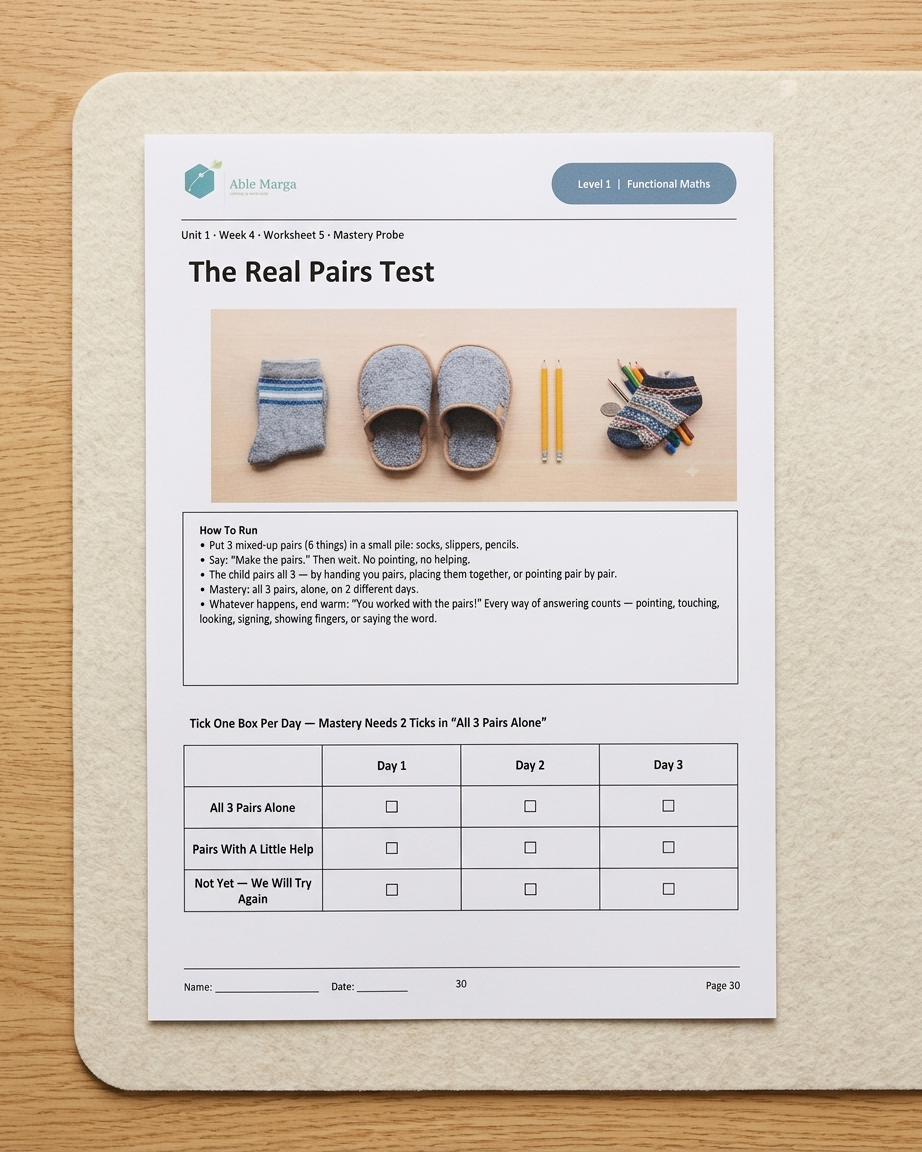
Able Marga worksheets turn big skills into small, teachable steps. Choose a subject and functional level, download the print-ready PDF and teach using the built-in prompts. Start with enough support for success, then reduce it gradually. No reading, writing or specialist training is required for early-level activities.
Your teaching path Short daily sessions
  1. 01
    Choose subject and level Match the activity to current functional ability.
  2. 02
    Download and prepare Print the required pages and activity cards.
  3. 03
    Teach with enough support Help the learner respond correctly before testing.
  4. 04
    Fade prompts and generalise Reduce help and practise the skill in everyday life.
The goal is not to finish the most pages. The goal is a skill the learner can use with less support.
Choose by functional level
Built-in teaching prompts
Multiple response methods
Progress toward independence
The complete process

From choosing a level to using the skill in real life

The worksheet is one part of a teaching sequence. Placement, prompting, repetition, progress review and real-life practice work together.

Parent using structured learning materials with children at home
Use the structure anywhere At home, in therapy, in a resource room or in a special-needs classroom.
01

Choose a subject and functional level

Select Life Skills, Functional Maths, Functional English or Social and Communication. Place each subject separately according to what the learner can already do—not age alone.

Use the placement guide →
02

Download the print-ready PDF

After checkout, the purchased PDF is delivered through your account and email. Print the pages and prepare any required cards or visual materials.

03

Teach with built-in, errorless prompts

Demonstrate, point, gesture or guide the response before the learner repeatedly makes an error. The activity notes explain what to present and how the learner can respond.

04

Fade support, review and generalise

Reduce prompts as the learner becomes more successful. Review progress and practise the same skill using different materials, people and real-life routines.

What prompting looks like

Give enough help for success, then make yourself less necessary

Prompt fading is not suddenly removing all help. Support is reduced gradually so the learner can take over more of the response.

Example activity

“Show me the toothbrush.”

The target remains the same. What changes is the amount of adult support needed to identify the correct item.

P

Physical

Guide the learner’s hand toward the correct picture or object.

G

Gestural

Point or gesture toward the correct choice without touching the learner.

V

Verbal or visual

Give a brief word, model or visual cue that helps recall the response.

I

Independent

Present the instruction and wait for the learner to respond without extra help.

The sequence is flexible: use only the amount of help the learner needs. Prompt type and order should be adapted where a therapist or educator has an individual plan.
What is functional academics?

Teach the reading, maths and communication a person uses in daily life

Functional academics connects academic concepts to participation, safety, communication and independence rather than teaching content only for a test.

Traditional focus

Content organised around school subjects

Traditional academics often prioritises grade-level reading, writing, arithmetic, science and history with standard classroom response methods.

  • Completing abstract arithmetic exercises
  • Reading content without an immediate daily-life purpose
  • Showing knowledge mainly through speech or writing
Able Marga focus

Concepts organised around real participation

Functional academics teaches academic skills through situations the learner is likely to meet at home, school or in the community.

  • Recognising signs, labels and familiar words
  • Counting objects and using money in everyday situations
  • Following routines, making choices and asking for help
Functional academics is not automatically a “lesser” curriculum. For many learners, it is the route that makes reading, maths and communication immediately meaningful.
Structured Able Marga worksheets arranged for a teaching sequence
More than individual worksheets A sequence with a starting point, guided teaching, review and real-life application.
Why structure matters

Stop searching for random pages. Follow a teaching sequence.

An individual worksheet can practise a skill, but it does not automatically tell you what should come before it, how much help to give or when the learner is ready to move forward.

The problem is often not the worksheet itself. The problem is the absence of a structure around it.
01
Establish a starting point Use entry skills and pre-activities to reduce guesswork.
02
Teach in a deliberate sequence Move from clearer, simpler responses toward greater demand.
03
Repeat with prompt fading Practise consistently while reducing adult support.
04
Review progress Compare accuracy, response method and prompt level.
05
Generalise beyond the page Use the skill with different materials and real routines.
Using Able Marga day to day

A short session with a clear beginning and end

You do not need to complete many pages at once. One focused activity taught well is more useful than a long session filled with struggle.

An example home or classroom session

Approximately 10–15 minutes
01

Prepare

Print one activity and organise any cards before the learner begins.

02

Introduce

Give one clear instruction and show the response if needed.

03

Practise

Repeat a manageable number of times with successful prompting.

04

Finish positively

End while the learner is comfortable and record the help used.

The methods behind the worksheets

Technical ideas translated into practical teaching actions

Parents do not need to memorise professional terminology. The useful part is understanding what each method changes in the teaching interaction.

01

Errorless teaching

Arrange enough help for a correct response, then reduce help after the learner understands the task.

02

Forward chaining

Teach the first step of a routine, then add later steps in order as earlier steps become more secure.

03

Prompt fading

Move from greater support toward gestural, verbal or visual cues and finally independent responding.

04

UDL and AAC support

Offer multiple ways to understand instructions and respond, including pointing, cards, speech, writing or AAC.

05

IEP-style objectives

Connect activities to observable functional targets that can be measured through accuracy, prompting and independence.

06

Sensory and interoception cues

Notice comfort, body signals and environmental needs that may affect participation in an activity.

Who teaches with Able Marga?

One teaching structure across home, therapy and school

The materials can support consistent practice across the adults involved in a learner’s daily life.

Parents

Follow practical guidance at home without needing a teaching qualification.

For parents →

Therapists

Use selected activities within speech, occupational or developmental goals.

For therapists →

Special-Needs Schools

Build a more consistent functional-curriculum structure across classrooms.

For schools →
Questions about the approach

How It Works FAQs

Answers about training, levels, therapy, reprinting and functional academics.

Do I need ABA or special-education training?

No formal training is required for parents to use the activities. Teaching prompts and response methods are explained in practical language so you can begin with one manageable activity.

Able Marga resources support educational practice but do not replace an individual assessment or therapy plan where professional services are needed.

How do I know which level to start with?

Match the learner’s current functional abilities to the level descriptions subject by subject. Do not choose from age or school class alone.

If the learner appears between two levels, begin with the lower one. Use the placement guide for a full comparison.

Can I use Able Marga alongside school or therapy?

Yes. Share relevant materials and current goals with the learner’s therapist or special educator so prompts, response methods and carryover practice remain consistent.

The professional remains responsible for deciding how the resource fits an individual therapy or IEP objective.

Can I reprint the worksheets?

You can reprint purchased resources for your own child or permitted students according to the licence supplied with the product.

Files should not be resold, publicly uploaded or shared outside the users covered by the applicable licence.

What is functional academics for special needs?

Functional academics teaches reading, maths and communication through skills used in daily life—recognising signs, handling money, following routines, making choices and asking for help.

The aim is to make academic learning directly relevant to participation, safety and independence.

Ready to begin?

Choose one useful skill and start with success

Use the placement guide to choose a functional starting point, explore the live Level 1 subjects or try a free worksheet first.