Most parents of a two-year-old hear the same advice: “Play with them more.” But what does that mean on a busy Tuesday, between office calls, cooking and the school bus? And if your child has a developmental delay, autism or Down syndrome, you may be wondering which kind of play actually builds thinking skills.
The good news: the years from 2 to 5 are when the brain grows fastest, and short, daily, repeated activities do more than long, occasional ones. Ten focused minutes a day is enough to make a real difference.
What are the best brain development activities for toddlers?
The best brain development activities for toddlers are short, hands-on tasks that build one thinking skill at a time: drawing lines and curves (pre-writing), matching pictures, spotting the odd one out, copying simple patterns, remembering what was hidden, and sorting by colour or shape. Ten minutes a day, at the same time, with familiar pictures from your child’s own world works better than long sessions or screen apps.
The 8 early thinking skills that matter most
- Pre-writing strokes: standing lines, sleeping lines, curves and circles, the building blocks of every letter.
- Two-hand drawing: one hand holds the paper, the other draws. It sounds small; it is a big coordination milestone.
- Matching: finding the same picture. This is the first step in reading and maths.
- Spotting: finding one thing in a busy picture, which trains attention.
- Patterns: red-blue-red-blue. Patterns are early maths and early logic.
- Memory: “What was in the box?” Working memory supports following instructions.
- Sorting: fruits here, vehicles there. Sorting teaches categories.
- Simple reasoning: “Which one does not belong?”
Why familiar pictures matter for Indian children
A child who has never seen a fire hydrant or a pumpkin pie has to learn the picture before the skill. When the pictures are laddoos, autos, kites and mangoes, the child skips straight to thinking. This matters even more for children with autism or intellectual disability, who often learn best from what is already familiar.
Try this today: Put 3 steel bowls on the table and a banana in one. Cover them with a dupatta, count to 3, then lift it. Ask, “Where is the banana?” That is a memory game, and it cost you nothing.
How to run a 10-minute thinking session
- Same time, same place. After breakfast at the dining table works well for most families.
- Two pages, then stop. End while your child still wants more.
- Show first, then hand over. Do one example yourself, slowly.
- Help without taking over. Point to the answer, then tap near it, then just wait. Fade your help a little each day.
- Praise the effort. “You looked so carefully!” works better than “Good job.”
Is it only for children with special needs?
No. These are the same skills every preschooler needs. A child with autism, Down syndrome, ADHD or a speech delay may need more repetition and more help at first, but the activities themselves are the same. That is real inclusion: siblings can sit side by side and do the same page.
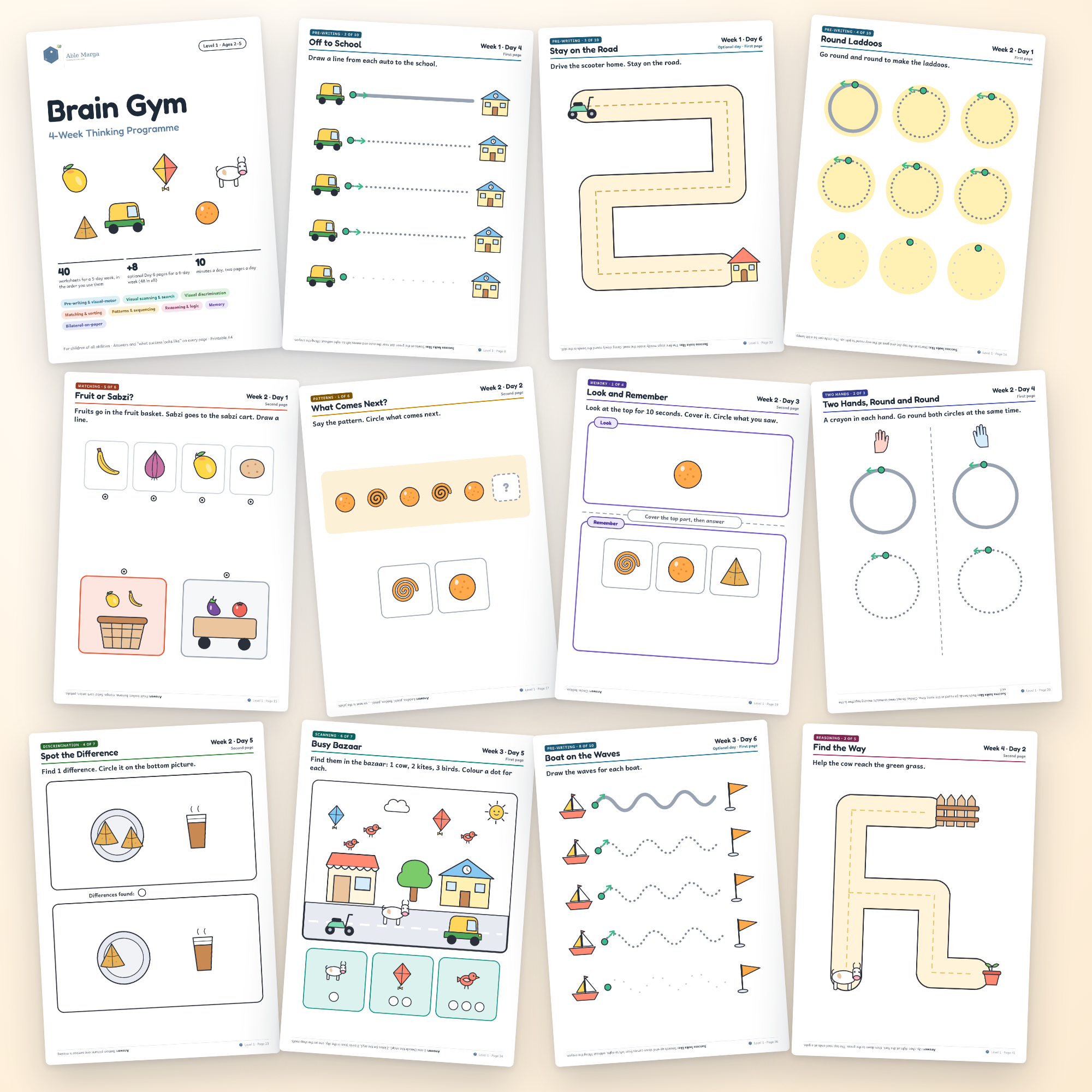
Brain Gym Level 1: a ready 4-week plan
If planning activities every day sounds tiring, Brain Gym Level 1 does it for you. It is a 4-week printable thinking programme for ages 2 to 5.
- Ten minutes and two pages a day, planned day by day for 4 weeks
- 8 thinking skills: pre-writing, two-hand drawing, matching, spotting, patterns, memory, sorting and reasoning
- Indian everyday pictures your child already knows
- Easy-to-hard order, with answers on every page
- Instant PDF download. Print at home on A4.
It costs ₹99. Ready for the next step? Brain Gym Level 2 continues the programme for ages 5 to 10.
Frequently asked questions
At what age can my child start?
From around age 2, or whenever your child can hold a crayon and sit for 5 minutes. A child working at a younger level can start later; go by ability, not age.
My child scribbles and won’t stay on the line. Is that okay?
Yes. Scribbling is the first stage of pre-writing. Use thick crayons and short lines, and guide the hand gently at first.
Are worksheets better than toys?
Neither is better. Short paper tasks and play build different things. Use both, and keep paper time short and happy.
When should I talk to a professional?
If your child is not pointing, babbling or responding to their name by 12 to 18 months, or loses skills they had, speak to a developmental paediatrician. Early intervention works best when it starts early.
Ten minutes. Two pages. Every day. That is how little thinkers grow.