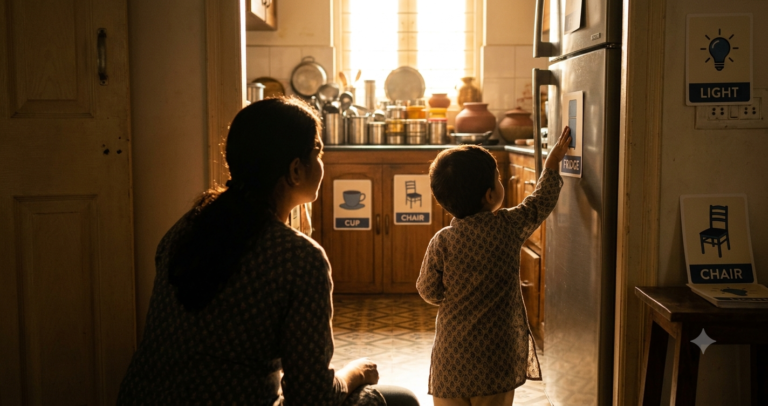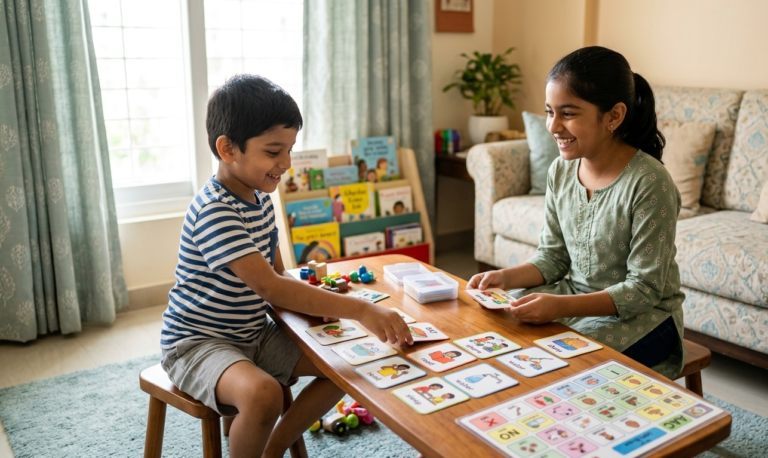
Your child pulls your hand to the fridge. Or cries until you guess right: water? biscuit? the TV? Many parents of non-verbal or minimally verbal children spend their day guessing. Every wrong guess means frustration, for both of you.
AAC can end much of that guessing. Yet many Indian parents hesitate, often because a relative or even a professional has said, “If you give him pictures, he will never talk.” Let us look at what AAC really is, and what it is not.
What is AAC, and will it stop my child from speaking?
AAC (augmentative and alternative communication) is any way of communicating that adds to or replaces speech: picture cards, sign, gestures, a communication board or a speech app. Research does not show that AAC stops children from talking; many children who use AAC go on to say more words, because communicating successfully builds the wish to communicate again.
4 myths that keep parents waiting
- “AAC is a last resort.” It works best when started early, alongside speech therapy, not after years of waiting.
- “My child is too young.” There is no minimum age. Toddlers can learn to hand over a picture.
- “My child must first match pictures.” Not needed. Children learn what pictures mean by using them to get things they want.
- “It is only for children who will never speak.” AAC is for any child whose words are not yet enough for daily needs.
Start with “I want”
The fastest first win is requesting. When a child hands you a picture of a banana and gets a banana straight away, they learn that communication works.
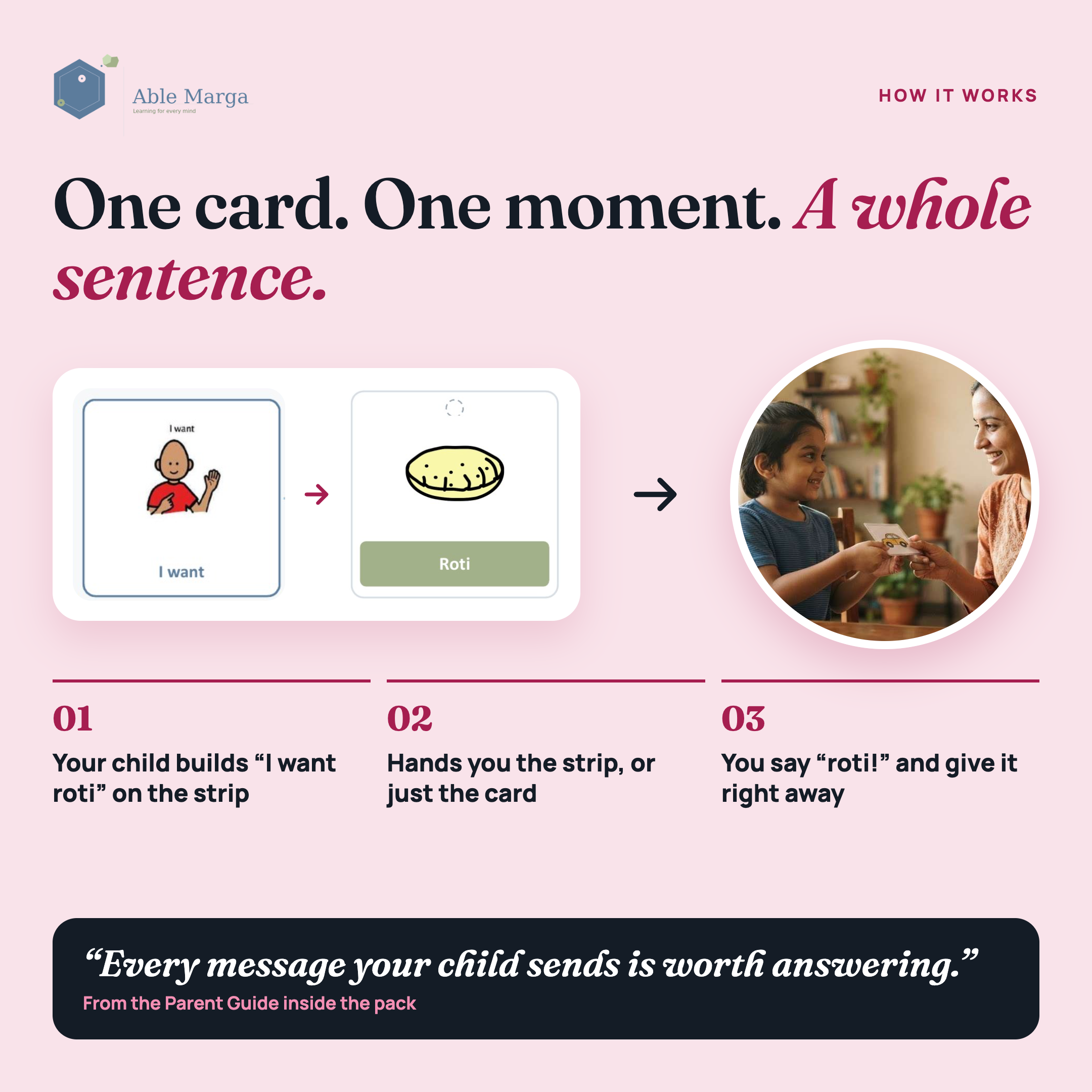
- Pick 3 favourites your child asks for every day, like water, biscuit and swing.
- Hold the item and the card together. When your child reaches, guide their hand to the card and into your hand.
- Give the item immediately and say the word: “Biscuit!”
- Fade your help day by day, until your child brings the card alone.
- Add the sentence strip: “I want” + card. Then add more words.
Golden rule: Every card your child hands you is a real message. Answer it, even if it is the tenth biscuit request. If the answer must be “no”, show a “not now” card and offer a choice instead.
Why real Indian photos help
A cartoon of a sandwich does not look like your roti. Real photos of everyday Indian foods, places and people (Dadi, Naani, the park, the kirana shop) help many children connect the card to the real thing faster.
Two Able Marga packs to get started
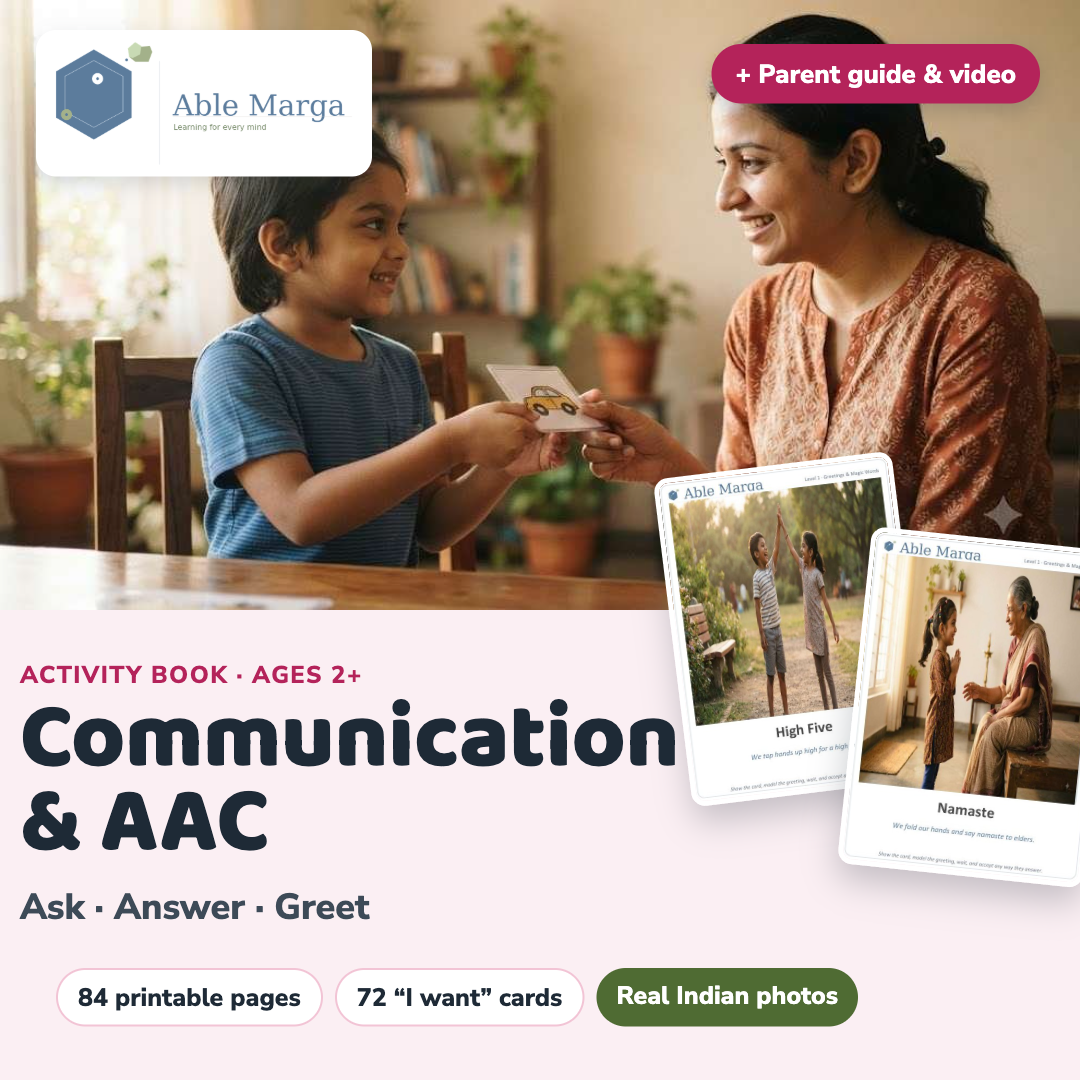
Communication & AAC Activity Book + Parent Guide (₹299) is an 84-page printable pack for children with few or no words.
- 72 “I want” picture cards across food, drinks, play, places, people, clothes and routines
- Real-photo cards for yes, no, choosing and greetings
- A 6-page parent guide that walks you through the first weeks
- Cards work on a ring, a lanyard or a velcro board
Communication & AAC — First Requests (₹299) focuses on the very first stage: first requests, simple choices and non-verbal communication.
Frequently asked questions
Do I need an expensive device?
No. Paper cards are a proven, low-cost start. Many families move to an app later, and many never need one.
How long until my child uses the cards alone?
It varies. Some children hand over a card within days; others take weeks. Consistency matters more than speed.
Should I still do speech therapy?
Yes. AAC and speech therapy work best together. Show your therapist the cards so everyone uses the same words.
Every child has something to say. AAC gives them a way to say it today.