Relatives sometimes say, “She doesn’t even say namaste,” or “He doesn’t care when his brother cries.” For a parent, these comments hurt. And they are usually wrong.
Many autistic children feel emotions deeply. What is hard is recognising feelings, naming them and knowing what to do with them, in themselves and in others. The same goes for greetings and manners: they are not instinct, they are learned rules. And rules can be taught.
How do you teach emotions to a child with autism?
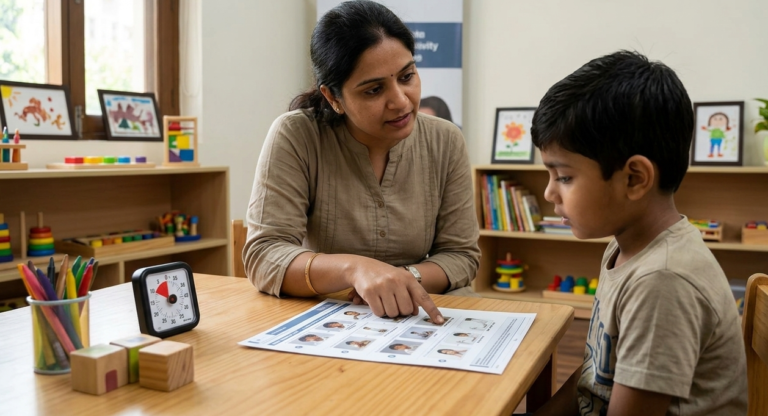
Start with four basic feelings (happy, sad, angry and scared) using real photos of faces, not cartoons. Name feelings as they happen (“You are angry because the tower fell”), link each feeling to a body clue and an action, and practise with short role-play at calm times. Teach greetings and manners the same way: one clear script, shown with a photo, practised daily.
Step 1: Name the feeling in the moment
Be your child’s “feelings narrator”. When it happens, say it simply:
- “You are happy. You got the swing!”
- “You are sad. Naani went home.”
- “I am angry. The milk spilled. I will take a breath.”
Naming your own feelings is powerful too. It shows that everyone has feelings, and that they can be handled.
Step 2: Link feeling, body and action
| Feeling | Body clue | What I can do |
|---|---|---|
| Happy | Smile, jumping | Share it: “Look, Mummy!” |
| Sad | Tears, quiet | Ask for a hug |
| Angry | Hot face, tight fists | Take 3 breaths, ask for a break |
| Scared | Fast heart, hiding | Go to a safe person |
Step 3: Teach manners as simple scripts
Manners feel natural to many people, but for many autistic children they need to be taught one by one:
- Greeting: “Namaste” or “Hi” with a wave when someone comes home
- Magic words: please, thank you, sorry
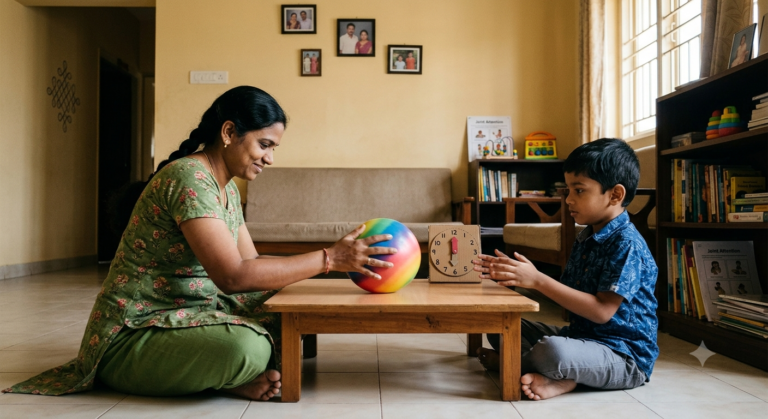
- Turn-taking: “My turn, your turn”
- Leaving: “Bye, see you”
Practise with family photos before the next function, so the greeting is ready when Bua arrives.
Respect first: Some autistic children find eye contact or hugs uncomfortable. A wave, a namaste or a high five is a perfectly good greeting. Teach a choice, not a performance.

Two Able Marga packs for social and emotional learning
Social & Emotional Starter Pack (₹299): visual cards for greetings, manners, feelings and early social understanding. A simple, focused way to start.
Social & Communication — Level 1 Complete Set (₹999): our full-year, card-based curriculum with 400+ real-photo cards across 11 units, including Greetings & Magic Words, I Want I Need, Yes No & My Choices, Emotions & Feelings, What Happens Next?, My Turn Your Turn, and My People & Who Helps Me.
For teens and young adults, Everyday Choices takes the next step: choosing a calm action in 50 real-life situations. Read more in our guide to social skills training for autism.
Frequently asked questions
My child laughs when someone is hurt. Does that mean they don’t care?
Usually not. Laughing can be a response to stress or to a sudden event the child does not understand. Calmly name what happened: “Rohan fell. He is hurt. We say, are you okay?”
Should I use cartoon faces or real photos?
Real photos usually transfer better to real life, especially for concrete thinkers. Cartoons can be a starting point for some children.
When should I see a professional?
If your child cannot calm down for long periods, has frequent aggression, or seems very anxious, talk to a psychologist or behaviour therapist experienced with autism.
Feelings are not a problem to fix. They are a language to learn, together.