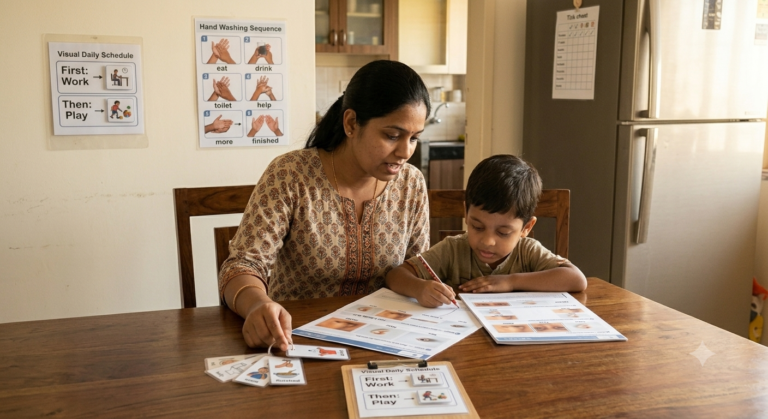
A functional curriculum teaches the skills a person actually uses in daily life — handling money, reading signs, getting dressed, asking for help — instead of academic content ordered by school grade. For a child with autism, an intellectual disability or a developmental delay, these are the skills that carry over into real independence.
It is built around one question: will the child use this skill outside the classroom? If the answer is no, it waits.
Functional curriculum vs academic curriculum
A regular school curriculum moves through reading levels, long division and grammar on a fixed grade timeline. A functional curriculum starts from where the child is and teaches what the day in front of them demands: telling a ₹10 note from a ₹20 one, reading STOP and EXIT, matching a spoon to the spoon stand. The order is set by usefulness, not by age.
Who it is for
Children and young people with autism, intellectual disability or developmental delay — and the parents, special educators and therapists who work with them. A good functional curriculum is written so that any adult at home can deliver it, with a parent-instruction note on every page telling you exactly what to say and do. No therapy background is assumed.
The four parts of a functional curriculum
A complete functional curriculum covers four connected areas:
- Functional academics — the maths and English used in real life (functional maths and functional English).
- Life skills — self-care, home routines and community tasks (life skills).
- Social & communication skills — greetings, requesting, choosing, emotions.
- Behaviour & self-regulation — responding calmly instead of reacting.
What makes it actually work
Six things separate a functional curriculum that teaches from a stack of printables that don’t:
- Relevance before rigour — the skill earns its place by being used.
- Real-world, local context — rupee notes, autos, the kirana store, road signs, the kitchen, the mandir or masjid — not clipart from another country.
- Visual support on every page — pictures carry the meaning, so reading is never the barrier.
- Errorless learning — the page is built with enough support that the child succeeds from day one; prompts are then faded across the series.
- Generalisation — the same skill is practised across different materials, people and places until it holds everywhere.
- No reading or writing required to start — the first level needs neither.
How to begin
Start by placing the child on current skills, not age — a placement guide matters more than a birthday. Pick one area to begin with, usually life skills or functional maths. Use printable units a parent can run with the built-in script, and practise each skill in the real setting it belongs to.
FAQ
What is a functional curriculum? A functional curriculum teaches the everyday skills a person needs to live more independently — money, reading signs, self-care, communication — rather than academic subjects ordered by grade.
How is it different from a regular school curriculum? A school curriculum follows a grade timeline. A functional curriculum follows usefulness: it teaches what the child will use outside the classroom, starting from their current level.
At what age should a child start? There is no fixed age. Placement is by current skill — what the child can already do — using a placement guide rather than their birthday.
Do I need a special-education background to teach it? No. A well-made functional curriculum carries a parent-instruction note on every page, so any adult at home can deliver it.
Call to action
Try it before you buy: download a free 25-page unit from the Free Worksheets page. When you’re ready for the full programme, browse the full-year functional curriculum — four subjects across six levels, built on Indian daily life.