
Printable picture cards is the easy part. Most families print it within a week of hearing the advice, and most sets end up in a drawer within a month. The difference between a set that works and one that gathers dust is almost entirely in how you introduce them.
Which picture cards should I start with?
Start with a small set of high-motivation requests — usually eat, drink, toilet, help, more and finished. Print them, laminate for durability, and keep them where the activity happens. Teach use by prompting your child to hand over or point to the card, then responding immediately every single time.
Choosing the first cards
The instinct is to start with things you want your child to do. Start instead with things your child wants. A card for a favourite biscuit gets used; a card for “sit down” does not.
- Two or three strongly motivating items to begin — a specific snack, a favourite toy, going outside
- Then core requests — more, finished, help
- Then daily needs — toilet, water, food
- Only later, activity and behaviour cards
Making them
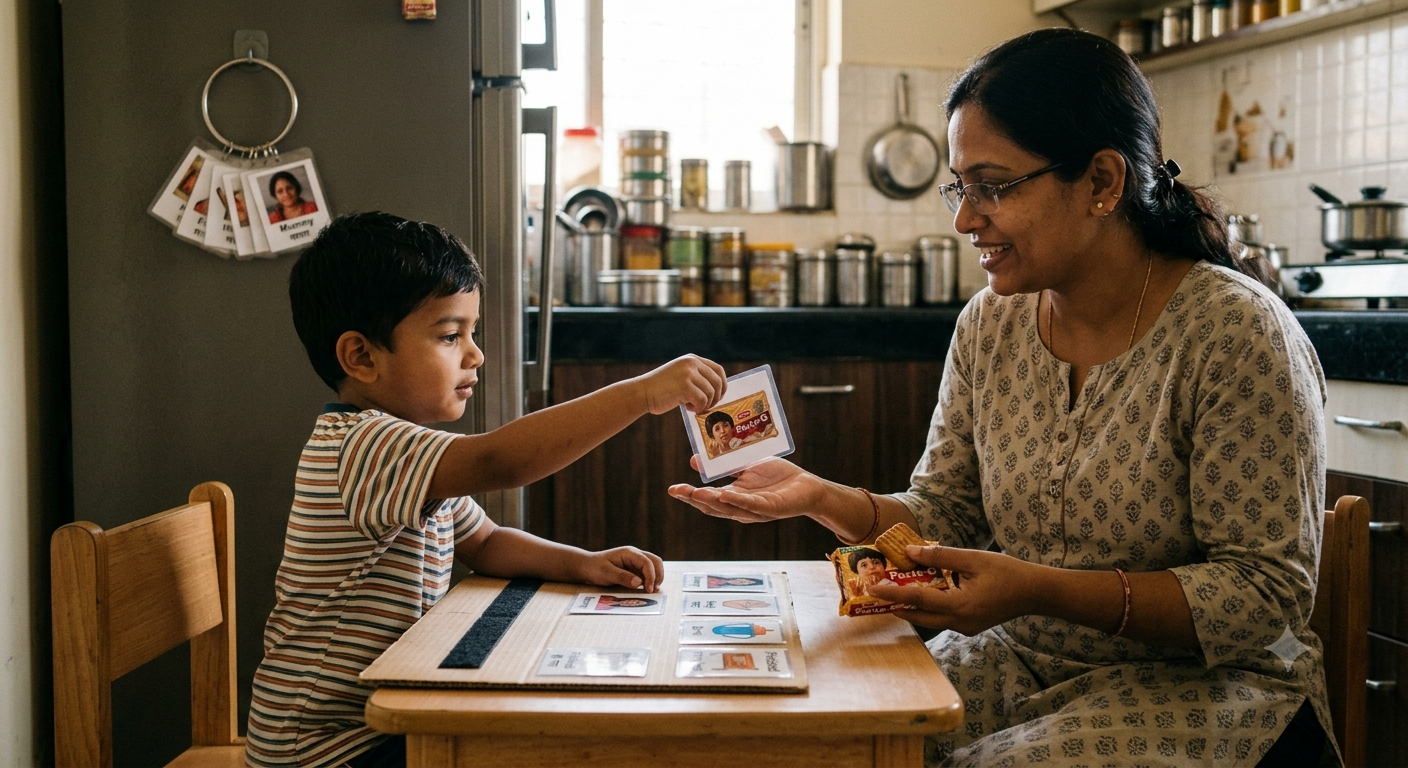
- Use photographs of your child’s actual things where you can — their tumbler, their biscuit packet. Real photos transfer far better than generic symbols.
- Print at around 5cm square, one image per card.
- Laminate, or cover with clear tape as a cheap alternative.
- Add velcro dots so cards can be moved and handed over.
- Keep sets small and portable — a metal ring or a strip on the fridge.
The first exchange, step by step
This is the part that decides whether the system takes.
- Hold the desired item where your child can see it but not reach it.
- Have a second adult behind your child gently guide their hand to pick up the card and place it in your hand.
- The moment the card touches your hand, give the item immediately and name it once — “biscuit”.
- Repeat many times across days, fading the physical guidance.
- Gradually increase the distance so your child must bring the card to you.
Respond every time, at least at first. If your child hands over the biscuit card and sometimes gets a biscuit and sometimes gets “not now”, the system is unreliable and they will abandon it. Once it is well established you can introduce waiting — but not before.
Why sets fail
- Started with compliance cards rather than motivating ones
- Kept in a folder rather than where they are needed
- Used by one parent and not the other
- The child was expected to understand without the guided first exchanges
- Too many cards introduced at once
Does this stop speech developing?
No — and this worry stops many families from starting. Evidence indicates picture-based communication supports rather than delays speech. Reducing frustration and giving a child a working way to communicate tends to encourage spoken language, not replace it.
Frequently asked questions
How many cards should we start with?
Two or three highly motivating ones. Expand only once those are used spontaneously.
Photos or drawn symbols?
Photographs of your child’s own belongings first. Move to symbols later if your child understands them.
My child just points at the item instead.
That is communication too, and worth accepting. Cards become more useful when the item is out of sight or out of reach.
Able Marga units include cut-out picture and word cards designed for Indian homes and printed on standard A4. Download a sample unit for free https://able-marga.kit.com/752a82f9ec