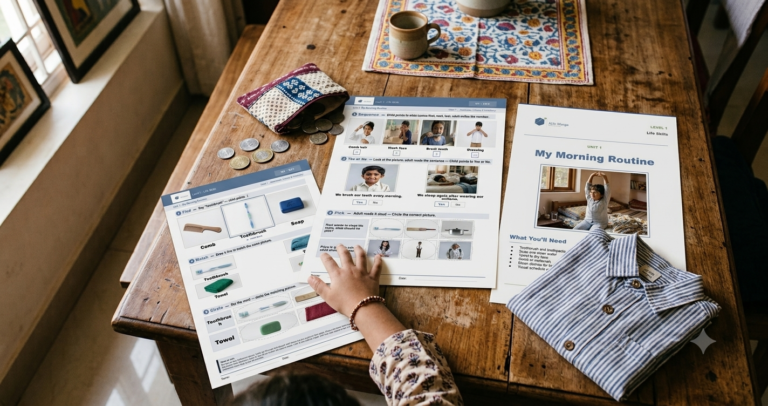
A functional maths curriculum teaches the numbers a person uses to get through a day — counting out change, telling a ₹10 coin from a ₹50 note, knowing when a cup is full, reading the time on a clock. It leaves aside the algebra and long division of a school syllabus and keeps what builds independence.
For a child with autism or an intellectual disability, that shift is the whole point: a skill is taught because it will be used at the shop, in the kitchen or on the bus.
What a functional maths curriculum covers
The skills build in order, each one resting on the last:
- Match and sort — putting the spoon with the spoons, the shoe on the rack.
- Colours, shapes, big and small — the vocabulary numbers sit on.
- More, less and same — the first real number sense.
- Numbers you can see — recognising numerals 1 to 5 by sight.
- Counting real objects and showing numbers on fingers.
- Coins and notes — telling rupee coins and notes apart, up to ₹50.
- Full, empty and half — quantity in the real world.
From there it extends into the skills that matter most for daily living: money (paying, change, “do I have enough?”), time (clock, dates, routines) and measurement (length, weight, capacity).
Why the Indian context matters
Most functional maths PDFs you’ll find online teach dollars and cents, or use pictures of products an Indian child has never seen. A child learns money by handling the money they’ll actually use — real rupee notes and coins, kirana-store prices, the auto fare. A curriculum built on local life transfers; one built on someone else’s doesn’t.
Why PDF and printable works
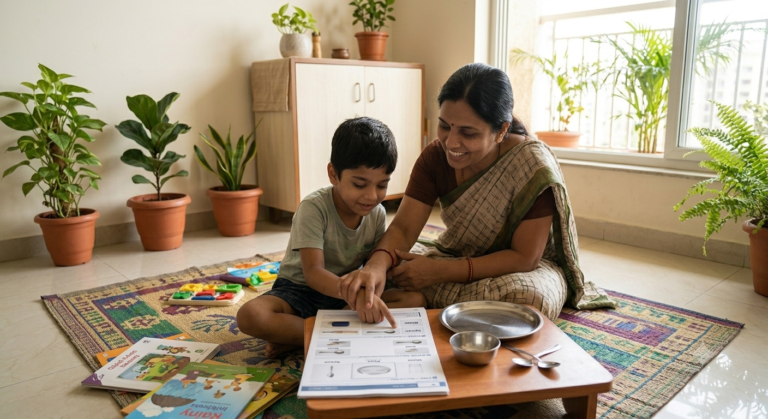
A printable PDF curriculum means a parent can start today, at the kitchen table, with nothing more than a printer. Every page carries a short instruction note telling the adult exactly what to say and do, so no therapy training is needed. Pages are built on errorless learning — enough support that the child succeeds from the first page, with prompts faded as the series goes on.
FAQ
What is a functional maths curriculum? It teaches the everyday number skills a person needs to live independently — counting, money, time and measurement — rather than academic maths ordered by grade.
Is there a free functional maths PDF to try? Yes — a full 25-page unit is available free, so you can see the format and teaching style before buying anything.
What age is it for? Placement is by current skill, not age. The first level assumes no reading, writing or prior number knowledge.
Do I need to be a teacher or therapist to use it? No. Each page has a parent-instruction note, so any adult can deliver it at home.
Call to action
Download a free 25-page functional maths unit from the Free Worksheets page to try it. For the full programme, see the Functional Maths curriculum and skill packs — money, time and measurement, each built on Indian daily life.