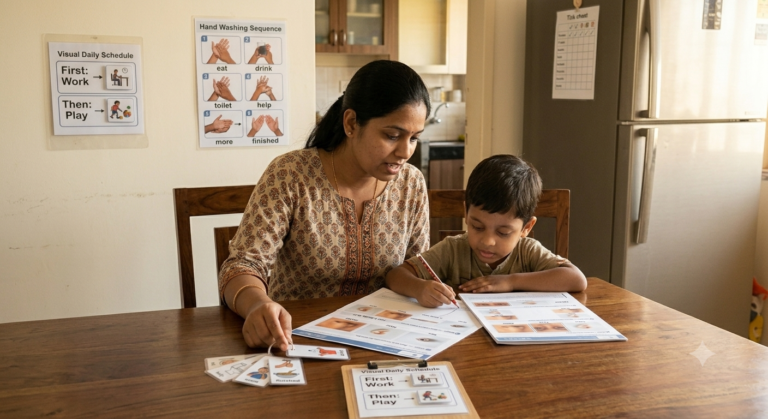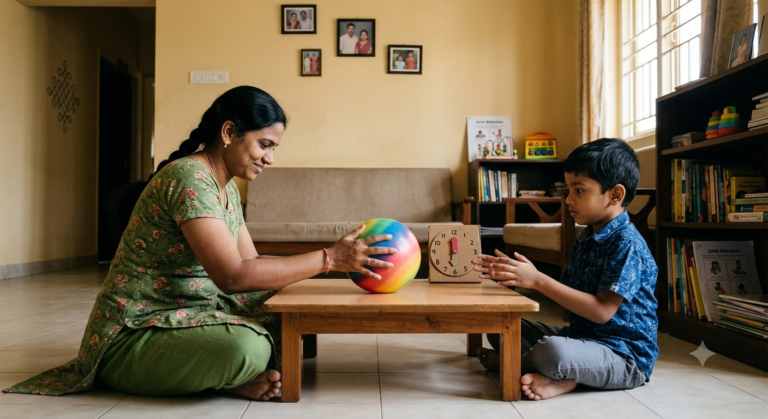

A parent once told me her son had repeated Class 3 maths for four years. Four years of the same worksheets, the same failures, the same widening gap. Meanwhile he could not tell a ten-rupee note from a hundred. That is the case for a functional curriculum in a single story — and it is a choice, not a compromise.
What is a functional curriculum?
A functional curriculum teaches the skills a person actually needs in everyday life — dressing, money, safety, reading signs, asking for help — rather than following grade-level academic content. It is organised by usefulness rather than by age, and it suits learners with intellectual disability, autism or significant learning needs.
How it differs from the standard curriculum
The standard curriculum asks: what should a child of this age know? A functional curriculum asks a different question: what does this particular child need to be able to do in order to live as independently as possible?
That changes everything downstream. Content is chosen by usefulness. Progress is measured against the child’s own starting point rather than a class average. And success looks like a young adult who can manage their own morning, not one who passed a paper.
What a functional curriculum covers
- Daily living: dressing, hygiene, toileting, eating, tidying
- Functional maths: money, quantity, measurement, time as sequence
- Functional literacy: signs, labels, own name, forms, safety words
- Communication: requesting, asking for help, refusing safely
- Social: turn-taking, greetings, personal space, community behaviour
- Safety: road, stranger, home and emergency awareness
Who it is right for
A functional curriculum suits a child who has been in the same academic content for years without progress, who is approaching the end of schooling without independence skills, or whose needs mean grade-level academics are not a realistic path.
It is not right for every child, and it should not be chosen by default. Some children need academic content with good support and will get there. The honest question is whether the current approach is producing progress — if it has not in two or three years, continuing is unlikely to change that.
This is not lowering expectations. It is a common worry and it deserves a direct answer. Expecting a child to keep failing at content they cannot access is not high expectations — it is a plan that is not working. A functional curriculum sets a high expectation for something achievable and genuinely valuable: independence.
Functional and academic together
These are not mutually exclusive, and the best plans blend them. A child might work on functional money skills while continuing phonics, or learn dressing routines while attending mainstream classes with support. The mix should reflect the individual child and should be reviewed as they grow.
How to start
- Assess honestly. List what your child can already do independently in each area above.
- Choose two or three priorities — the skills that would change daily life most.
- Break each into steps using a task analysis.
- Teach one step at a time with prompting and fading.
- Track it with a simple pre-test, notes, and a post-test.
- Practise in real settings so the skill generalises.
Frequently asked questions
Will my child fall further behind academically?
If academic content is not currently producing progress, the gap is already growing. Functional teaching converts that time into skills your child will actually use.
At what age should we switch?
There is no fixed age. Many families begin blending functional content from around eight to ten, when the academic gap becomes clear.
Can a functional curriculum be used at home?
Yes — it suits home teaching particularly well, because the skills are practised in the very settings where they are needed.
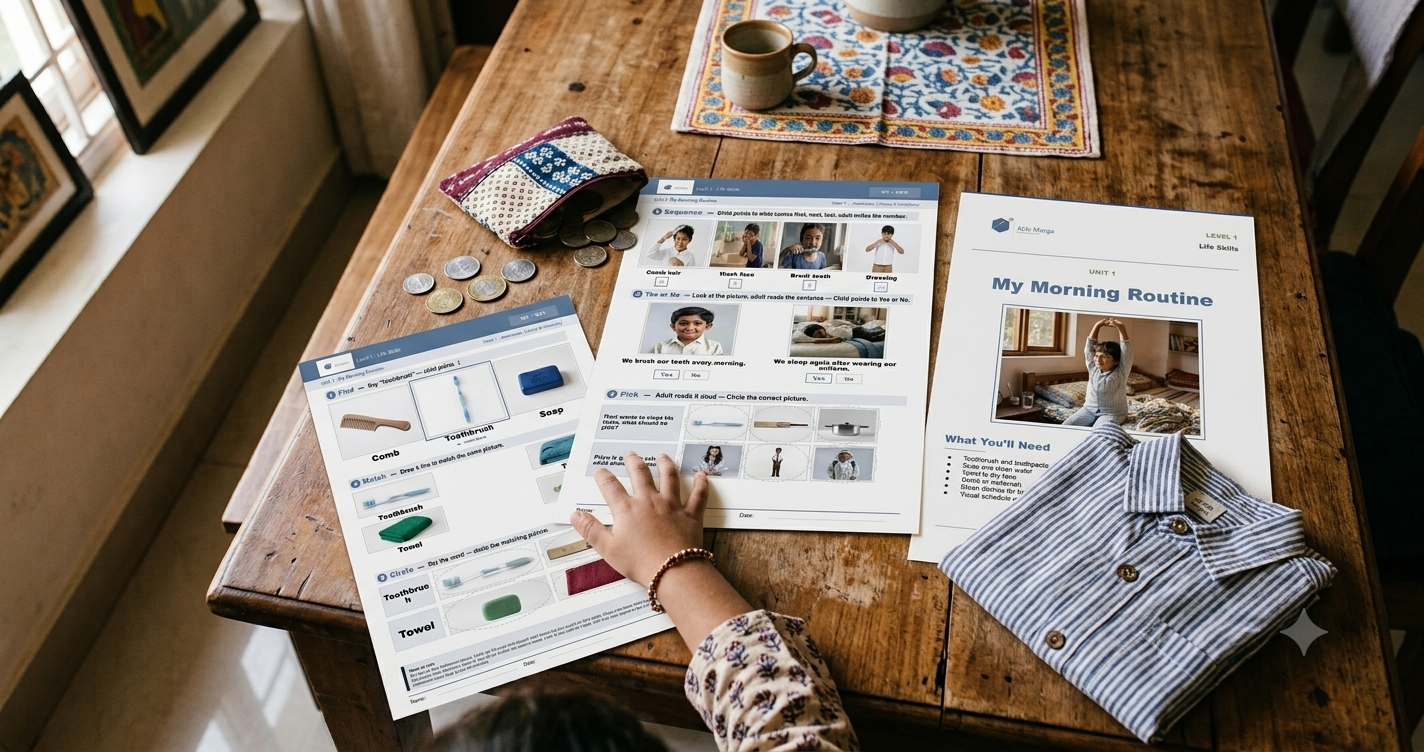
Able Marga is a functional curriculum built for Indian families — Life Skills, Functional Maths, Functional English and Social Skills, in printable levels with pre- and post-tests.