

There is no shortage of free autism worksheets online. There is a serious shortage of good ones. Most are ordinary school worksheets with a cartoon added, and using them tends to produce exactly what parents fear — a child who sees paper and walks away.
What makes an autism worksheet effective?
An effective autism worksheet teaches one concept per page, requires no reading or writing to complete, uses clear real-life images rather than decorative cartoons, and is designed so the child succeeds on the first attempt. It should also sit within a sequence rather than being a standalone activity.
The six-point test
Before you print anything, check it against these.
- One task per page. If it teaches two things, it will confuse rather than consolidate.
- No reading needed. If your child must read the instruction, you have made literacy a gate on every subject.
- No writing needed. Pointing, circling, matching or placing a card should be enough.
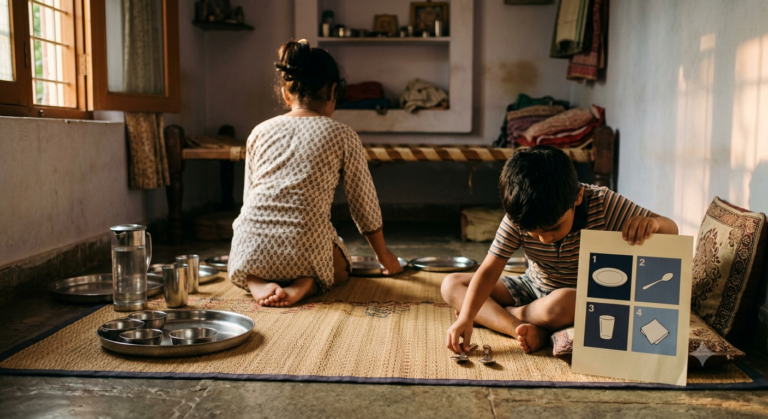
- Real, recognisable images. A photograph of an actual steel tumbler beats a cartoon cup.
- Generous white space. Crowded pages overwhelm.
- Errorless design. The correct answer should be reachable with a prompt, before a mistake happens.
What to skip
- Colouring pages presented as learning — pleasant, but they teach nothing specific
- Sheets with ten items where three would demonstrate mastery
- Anything requiring the child to copy from one part of the page to another
- Decorative borders and background patterns competing with the task
- Culturally unfamiliar images — a Western lunchbox means little to a child who eats from a tiffin
The bigger problem with free printables. Individually they can be fine. Collectively they are random — a matching sheet from one site, a counting page from another, with no sequence and no way to tell whether your child is progressing. A worksheet you cannot measure is entertainment, not teaching.
How to use a worksheet properly
The page is practice, not instruction. Teach the skill first with real objects. Use the worksheet to consolidate. Then take it into daily life so it generalises. Handed over cold, with nothing before or after, a worksheet is just a test — and children who fail tests stop trying.
Building a sequence from free material
If you are working entirely from free printables, impose your own structure: pick one skill, find or make four or five sheets that build on each other, run them across a fortnight, and keep a simple tick sheet of what your child could do at the start and at the end. That single change turns scattered printables into something you can actually evaluate.
Frequently asked questions
Are free worksheets good enough?
Some are excellent. Judge them against the six-point test rather than by how attractive they look.
How many should we do a day?
One or two, finished successfully, beats a stack half-done. End while it is still going well.
My child refuses worksheets completely.
Usually the level is wrong or past failure has made paper aversive. Drop to something they will certainly succeed at and rebuild from there.
Able Marga worksheets are built to all six points and arranged in levels, with a pre-test and post-test in every unit. https://able-marga.kit.com/83838a1543