

The phrase “early intervention” arrives with a weight attached — usually the implication that a window is closing and you are already behind. That framing helps nobody. What the evidence actually supports is simpler and far less frightening: starting sooner helps, and starting consistently helps more than starting perfectly.
What is early intervention for autism?
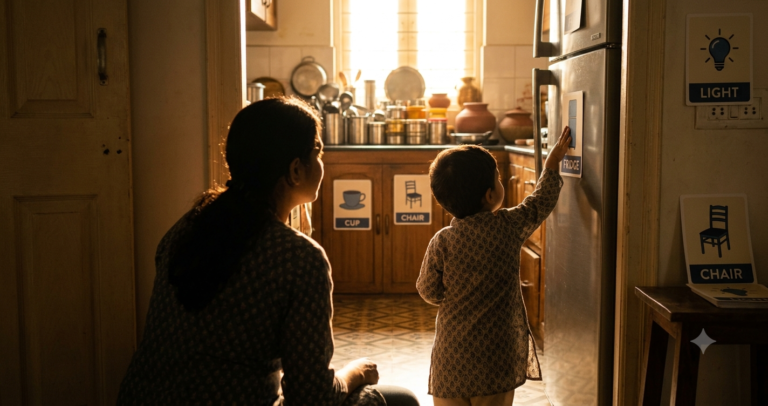
Early intervention means beginning structured support as soon as autism is identified, usually in the preschool years. It focuses on communication, play, social interaction and daily living skills rather than academics. Parents can begin at home immediately using visual supports, predictable routines and short, consistent teaching sessions.
Why earlier helps
Young children’s brains are highly responsive to input, and skills taught early tend to embed before unhelpful patterns settle. Just as importantly, early support prevents a secondary problem — years of frustration and failure that make a child avoid learning altogether. Much of what looks like an inability to learn at eight is actually accumulated avoidance.
If your child is older, this still applies. The window is not a door that slams. Children learn at six, ten and fifteen. Late is genuinely better than never, and older learners often progress faster on functional skills because the skills are immediately useful.
What to work on first
Before letters and numbers, four foundations make everything else possible.
- Joint attention — looking where you point, sharing a focus with you
- Imitation — copying your actions, which is how most learning happens naturally
- Requesting — asking for what they want, in any form, including pictures
- Following one-step instructions — “give me”, “come here”, “sit down”
These four are the scaffolding. Academic content built without them tends to collapse.
What early intervention looks like in practice
Professional services in India vary — speech therapy, occupational therapy, and ABA-based programmes where available, all typically for a few hours a week. That is valuable, and it is also a small fraction of a child’s waking life. The home programme is where the volume of practice happens.
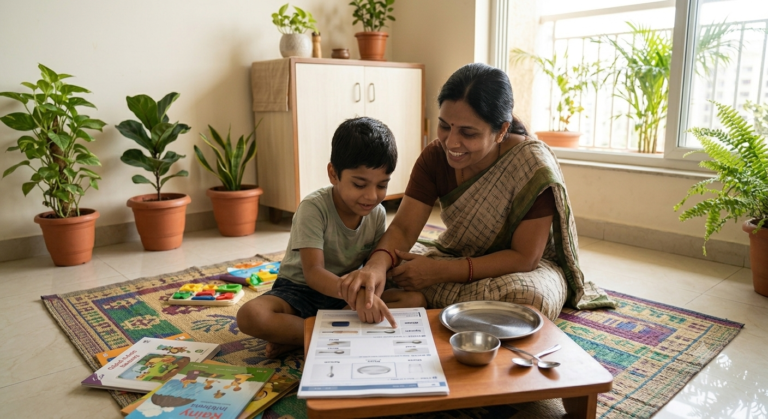
A workable home routine is three short sessions a day of ten to fifteen minutes each, always at the same times, on one or two target skills. Short and consistent beats long and occasional, every time.
Making it work at home
- Pick one skill. Just one, to start.
- Teach it at the natural moment — requesting at snack time, not at a desk.
- Prompt immediately so your child succeeds, then fade your help gradually.
- Respond fast when they get it right, so the connection is obvious.
- Note what happened in one line a day.
- Practise the same skill with different people and in different rooms.
The India reality
Waiting lists are long, services cluster in big cities, and costs add up quickly. If you are waiting for an assessment or a therapy slot, do not treat that time as empty. Structured teaching at home during the wait is real intervention, and for many families it ends up being the larger part of the programme.
Frequently asked questions
How many hours a week does my child need?
Recommendations vary widely and depend on the child. Rather than chasing an hours target you cannot sustain, aim for consistent daily practice you can genuinely maintain.
Can I do early intervention without a therapist?
Parents can teach a great deal at home. Professional guidance helps you target the right skills, so use it where you can access it.
Is it too late if my child is already six or seven?
No. Progress is possible at any age, and functional skills often come quickly with older learners.
Able Marga’s Level 1 units begin exactly at these foundations, in short printable steps with a pre-test so you know where to start.