
Most social skills teaching starts too far up the ladder. Parents are told to work on making friends, when the child has not yet learned to take a turn with a ball. Social skills build in a sequence, and starting at the right rung is most of the battle.
How do you teach social skills to an autistic child?
Teach in a sequence rather than all at once: joint attention first, then imitation, then turn-taking with objects, then sharing, then greetings and conversation. Each skill is taught explicitly with modelling, structured practice and real-life repetition, because most autistic children will not absorb it by observation alone.
The sequence
1. Joint attention. Sharing a focus with another person — looking where you point, showing you something. Everything social rests on this.
2. Imitation. Copying your actions. Children who imitate learn socially without being taught; children who do not need it taught directly.
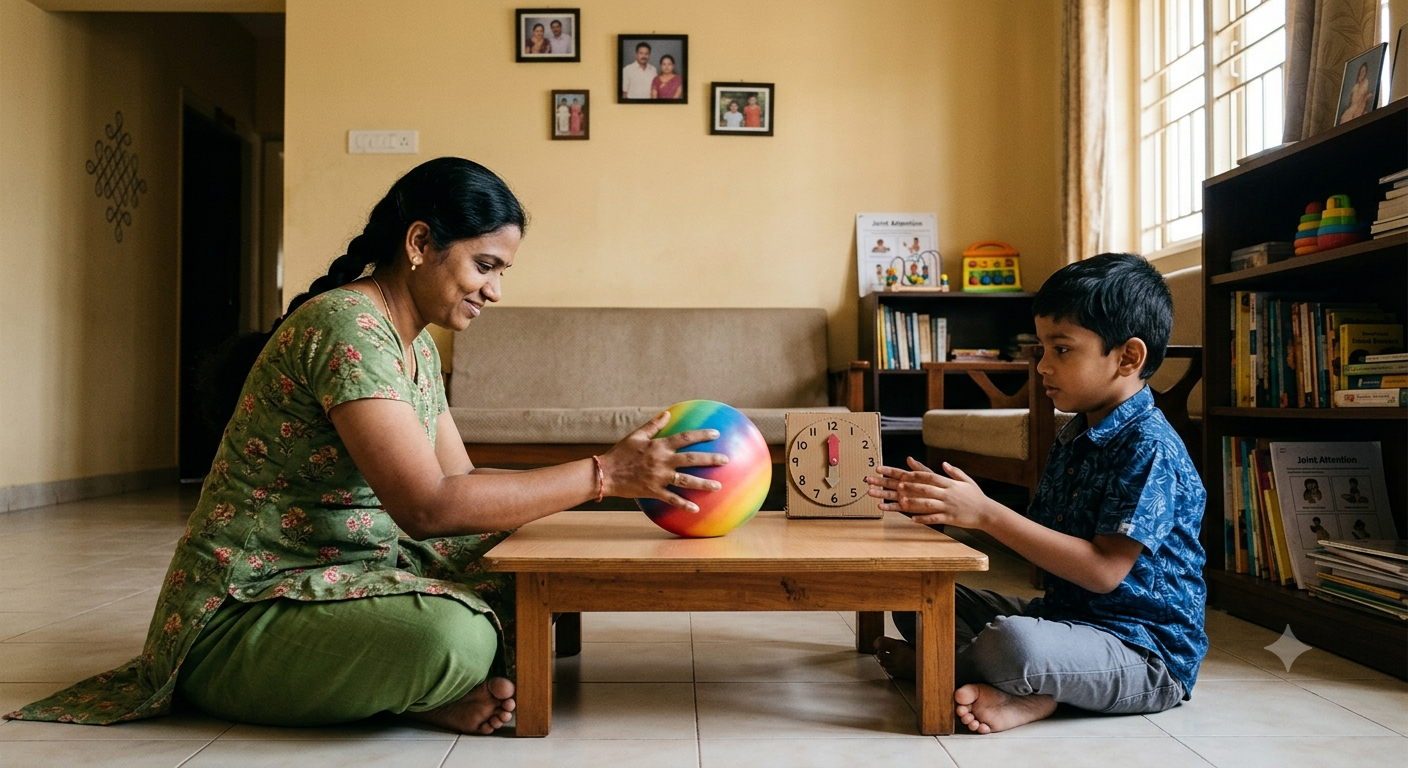
3. Turn-taking with objects. Rolling a ball back and forth. Concrete, visible, and far easier than turn-taking in talk.
4. Sharing and waiting. Tolerating not having the thing right now. Start with seconds, not minutes.
5. Greetings and simple exchanges. Hello, bye, thank you — in real situations, not drilled at a table.
6. Conversation. Asking a question, listening, responding. This is the top of the ladder, not the start.
If a skill is not progressing, drop down a rung. A child struggling with conversation almost always needs more object-based turn-taking. The problem is usually one or two levels below where it appears.
Four methods that work
Modelling. Show the behaviour rather than describing it. Have two adults demonstrate a greeting while the child watches.
Role play. Practise in a low-stakes setting first — at home, with you, before the real situation.
Video modelling. Film a sibling doing the skill and watch it together. Many autistic children respond strongly to video, and it can be replayed endlessly without anyone getting impatient.
Social stories. A short written and illustrated story preparing the child for a specific situation.
Practising with real people
Skills practised only with a parent tend to stay with the parent. Build in siblings and cousins, who are more forgiving practice partners than classmates. Then extend to a familiar neighbour, then a small group. Structured settings work better than free play, because free play requires all the skills at once with no support.
What not to teach
Some traditional social skills targets deserve a second look. Forcing eye contact is uncomfortable and sometimes distressing for autistic people, and many can listen better without it. Teaching a child to always comply with adults is a genuine safety risk. Aim for skills that make life easier for your child, not skills that make them look less autistic to onlookers.
Frequently asked questions
Should I insist on eye contact?
No. Encourage orienting towards a speaker if it helps, but forcing eye contact can be distressing and is not necessary for good communication.
My child plays alone. Is that a problem?
Not in itself. Start by playing alongside them without demands, then gradually add small exchanges.
Are group social skills classes worth it?
They can be, if the group is small and well matched. Check whether skills are practised in real situations or only discussed.
Able Marga’s Social Skills units follow this exact sequence, one skill per unit, with real-life practice built into every week. https://ablemarga.com/